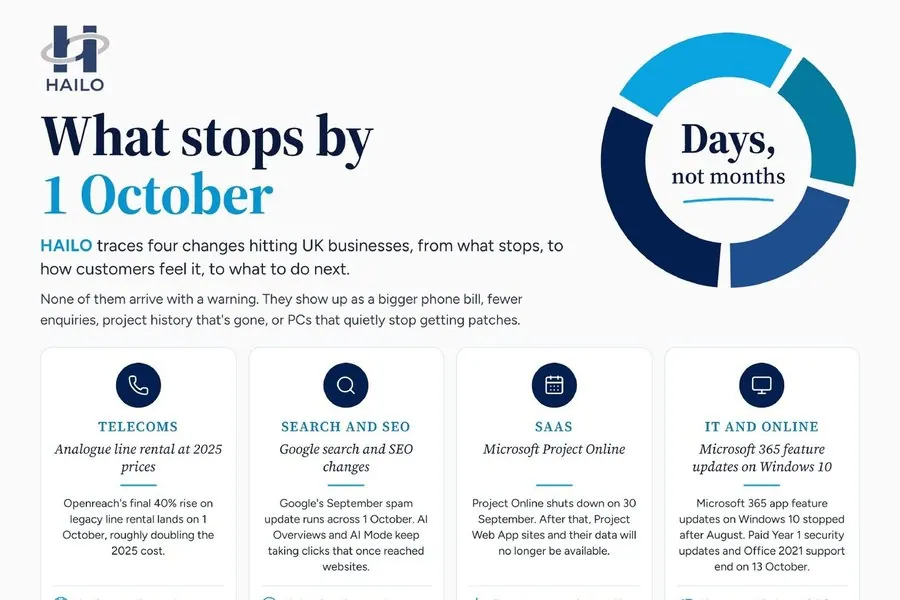
What stops by 1 October, and how customers feel it
Four changes hitting UK businesses around 1 October: what stops, how customers feel it, and what to do this week.
BlogInsight
Buyer's guide"Who are the best operations consultants for SMBs?" is the wrong question. The honest answer is that it depends entirely on which problem you have. Here is how to work out which type of provider fits, and how to tell the good ones apart once you are talking to them.
By HAILO · 8 min readFull disclosure: HAILO is an operations consultancy for UK SMBs, so we are one of the options described below. We have written this the way we would want it written if we were reading it. That includes the cases where the answer is not us.
Most business owners come to this decision after something has gone wrong twice. The month-end took a week again. A good enquiry went unanswered over a weekend. The person who understood the stock file resigned. The instinct is to search for help, and the search returns an undifferentiated wall of firms all promising transformation.
The difficulty is that "operations consultancy" covers at least five genuinely different businesses, priced an order of magnitude apart, solving different problems. Picking the wrong category is a more expensive mistake than picking a mediocre firm within the right one.
Before you contact anyone, work out which of these best describes your situation. It determines everything that follows.
That last one deserves a note. When a system fails to land, the reflex is to blame the tool and go shopping again. It is almost always the change that failed, not the software, so buying a second platform repeats the outcome at twice the cost.
| Type | Best for | Watch out for |
|---|---|---|
| Large / Big Four consultancies | Complex, multi-site or regulated transformation with budget to match | SMB engagements are rarely their core business; senior people sell, junior teams deliver |
| Boutique operations consultancies | SMBs needing diagnosis and implementation from the same team | Capacity is limited; check who is actually doing the work and when they are free |
| Independent consultants | A specific, well-defined problem in a sector they know deeply | Single point of failure; usually advice-heavy and build-light |
| Automation agencies / systems integrators | Building a solution when you already know exactly what you want | They optimise what you ask for; if the process is wrong you get it wrong, faster |
| Software vendors' professional services | Deep configuration of a platform you have already committed to | Every recommendation ends inside their product by design |
For most UK SMBs between roughly ten and two hundred staff, the realistic shortlist is boutique consultancies, independents and automation agencies. The question is then which of the three, and that comes down to how confident you are that you already know what to fix.
The single most useful filter. A report is not a result. Ask specifically who writes the automations, who configures the systems, and who is on the call when something breaks in week six. If the answer involves handing your recommendations to a third party you have not met, you are buying a document.
Good providers diagnose before proposing. You want the output to be specific: where the hours go, what each broken process costs annually, and what fixing it would cost, in enough detail that you could take it to another firm if you wanted to. If a firm proposes a solution before looking at how you work, that solution is their standard offering, not your answer.
Open-ended time and materials with no defined outcome puts all the risk on you. Fixed scope and fixed fee after diagnosis puts it in the right place. Ask for the total cost of the first outcome rather than a day rate. Day rates tell you nothing about how many days.
Ask directly about licences, data and the automations themselves. If the workflow lives in the consultancy's account, or the integration depends on their subscription, you have not solved a dependency; you have moved it outside the business, where you have less control than before.
Reseller commissions are legitimate and common. Undisclosed ones are not. A straight answer here tells you a lot about the rest of the relationship.
Adoption is where most operations work quietly fails. Ask what training is included, what documentation you get, and what the handover actually consists of. "We'll write SOPs" is a different answer from "your team runs it unaided for two weeks before we step back", and only one of them is testable.
Everyone has one. A provider who cannot name a difficult engagement and what they changed afterwards is either inexperienced or not being straight with you. This question has ended more of our own conversations usefully than any other.
Whoever you choose, the shape should be recognisable. Diagnose in one to two weeks. Prioritise by payback in about a week, with a fixed scope and fixed fee agreed at that point. Build over four to eight weeks, in production, with something usable landing early rather than everything landing at the end. Then hand over properly, so the improvement survives the consultancy leaving. That means documentation, training and ownership.
If a proposal does not have those four stages in some form, ask why. There are good answers. There are also proposals designed to keep a consultant on site indefinitely, and the difference is visible in the scope document.
Two cases. First, if you have not yet measured where the time goes, a fortnight of honest internal logging will tell you more than a discovery workshop will, and it costs nothing. Some businesses solve their own problem at that point. For them the answer turns out to be a report nobody needed or an approval step that never refuses anything.
Second, if leadership is not aligned on the change. Operations work reallocates how people spend their day, and that produces friction. If the owner and the leadership team are not agreed on the direction, external help will spend your money mediating rather than building. Sort that out first; the work will be cheaper and it will actually stick.
We are a boutique operations consultancy for small and mid-sized businesses, based in London and delivering remote-first across the UK. We diagnose, redesign and build: process re-engineering, workflow automation, connected systems and the knowledge capture around them, all on infrastructure you own. Fixed scope, fixed fee after the diagnostic.
We are a poor fit if you want a strategy document without implementation, if you need deep configuration of one specific enterprise platform, or if the work is genuinely large-scale multi-site transformation. In those cases the honest answer is a different type of provider, and we will say so on the first call.
The diagnostic puts a number on the hours and margin leaking out of your current process, before you commit to changing anything.

Human Accelerated Insights for Lean Operations
What stops by 1 October, and how customers feel it
Four changes hitting UK businesses around 1 October: what stops, how customers feel it, and what to do this week.
How to improve efficiency without hiring more staff
Capacity, not headcount. A guide for UK SMBs on finding the hours already inside the business: where to look and what to automate first.
How to fix spreadsheet sprawl without a rebuild
Spreadsheet sprawl costs UK SMBs hours every week and hides real risk. A five-step method to find, consolidate and replace them in the right order.